Day 21: System Concepts, Take n+1
This is another Zine day. If you picked a systems topic/concept to focus on, during Day 20's work, you have a head start on today's activity. On Day 16, perhaps you focused on Relationships and Interactions (looking back at previous days), or on Constraints (foreshadowing work on Day 19). At any rate, we're again working on pages of a Systems zine, covering important concepts in Systems.
If you already have a concept picked out, you can skip ahead. Otherwise, look over your lists of key ideas or concepts from Day 5 and Day 20.
Create a zine page on that topic, capturing related ideas, concepts, using expressive visual analogies and sketches to make ideas vivid.
If time remains, give another page a go. We only have a few days to complete a zine with 8 pages, including cover page and back page.
Here are some zine pages by Sebastian Hans:
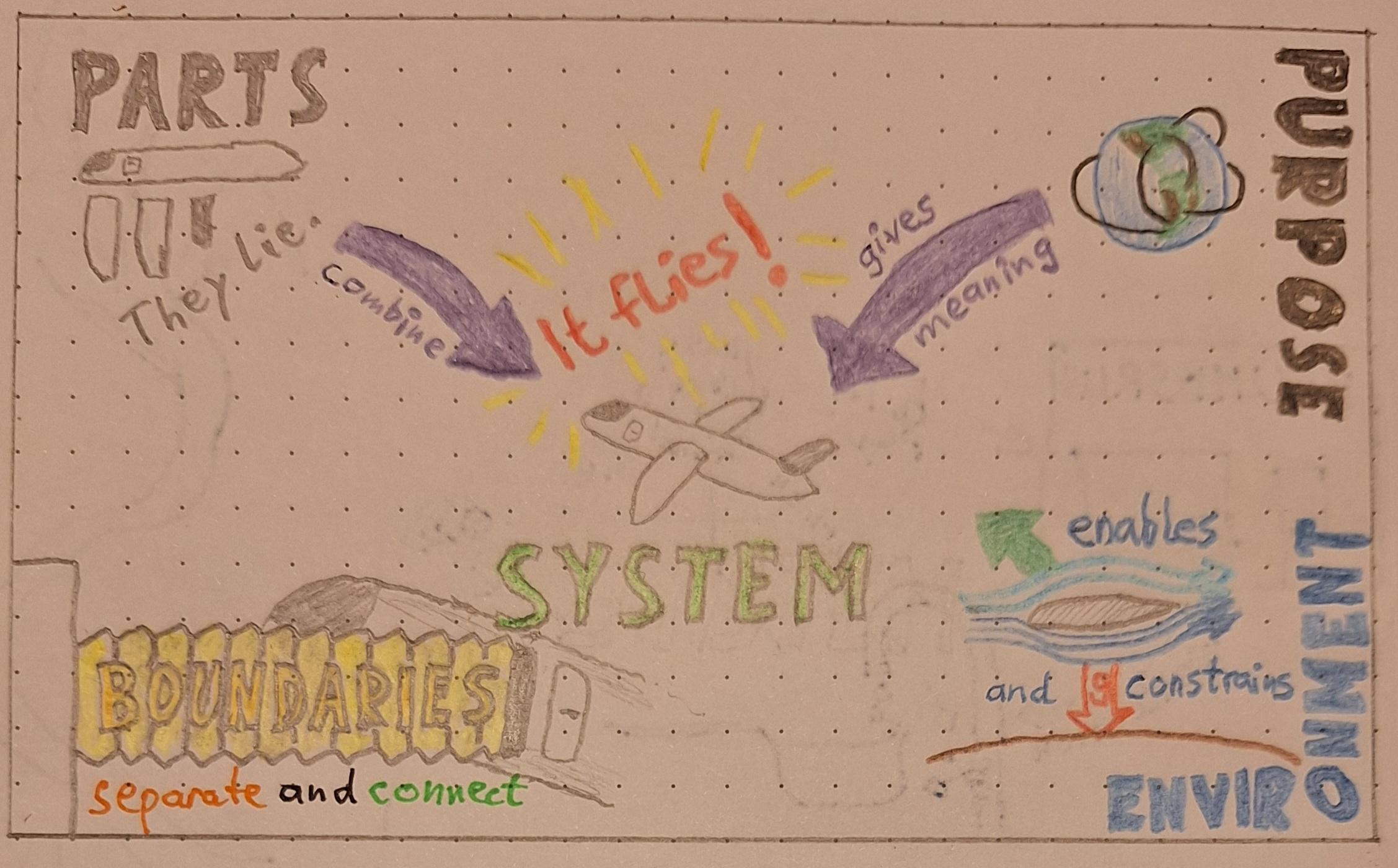
Day 5: System
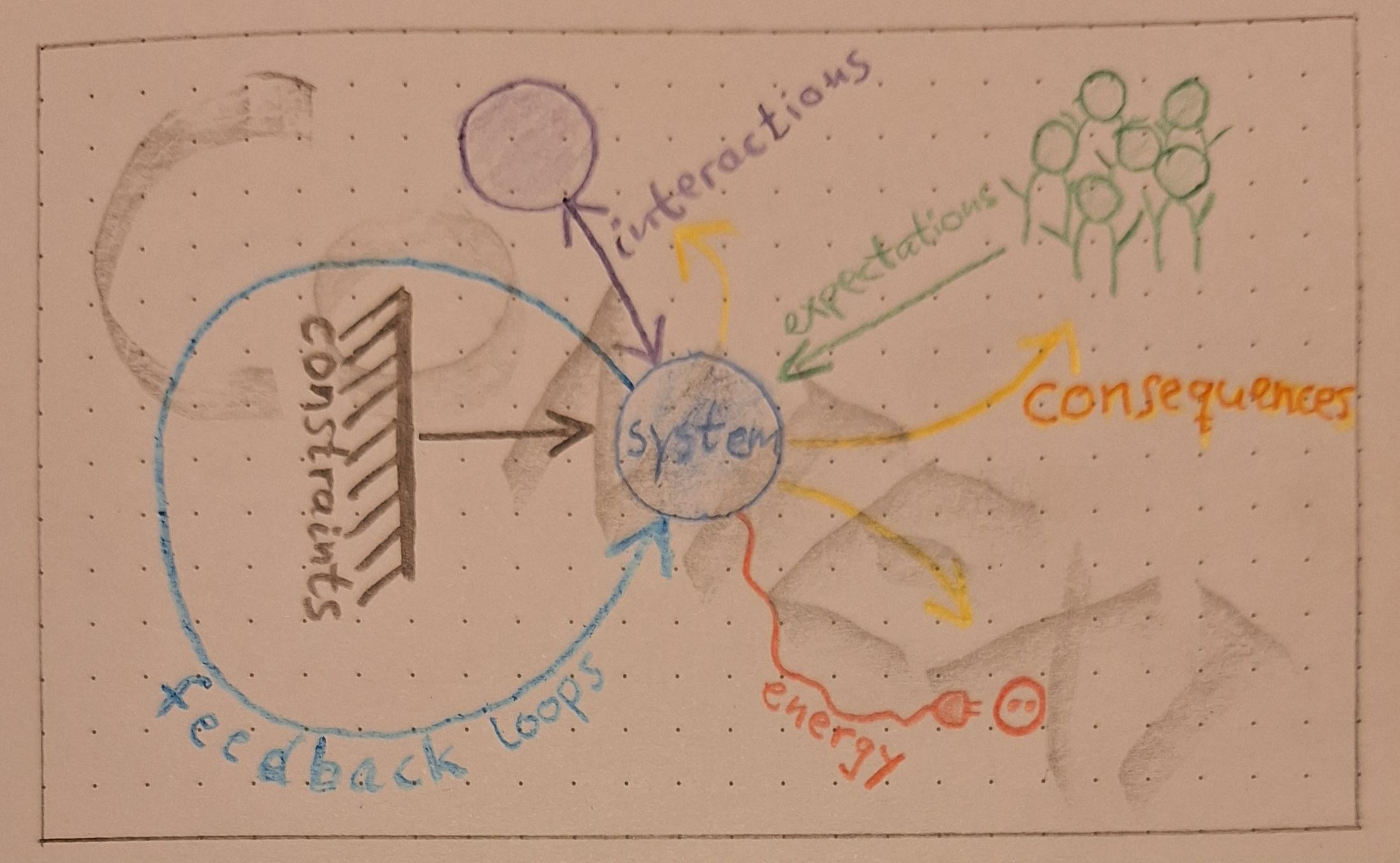
Day 8: Context
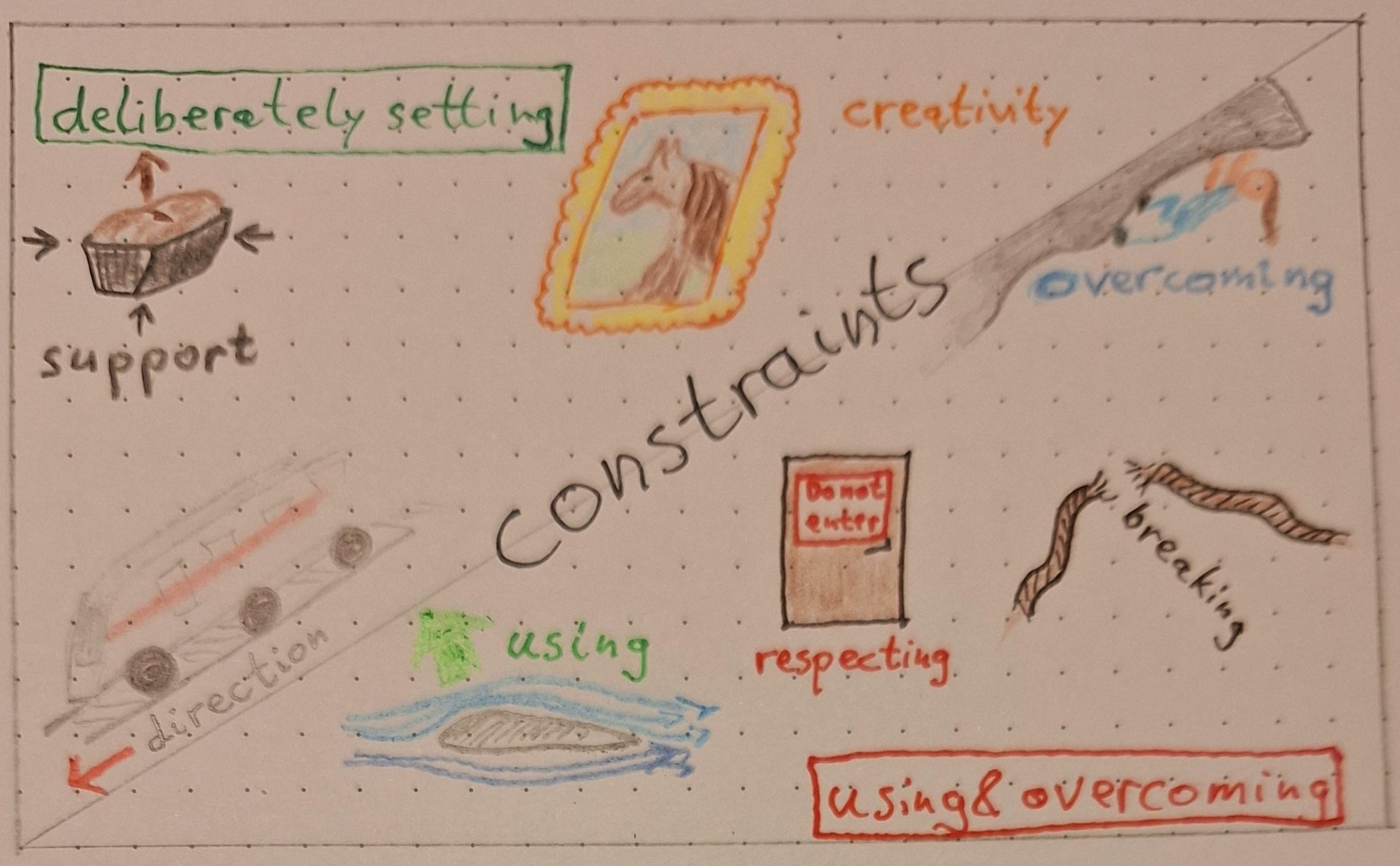
Day 16: Constraints
And from my System Seeing zine, created for a conference hands on session during the summer: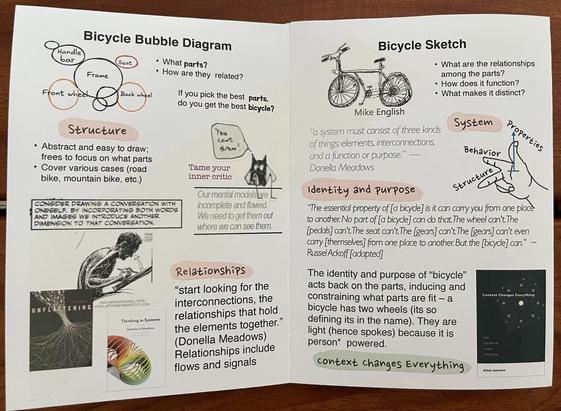
Pages of a System Seeing Zine
“First what's a system? A system as a whole, that consists of parts, each of which can affect its behavior or its properties.You for example are a biological system called an organism, and you consist the parts — your heart, your lungs, your stomach, pancreas, and so on — each of which can affect your behavior or your properties. The second requirement is that each part of the system, when it affects the system, is dependent for its effect on some other part. In other words, the parts are interdependent. No part of a system, or collection of parts of a system, has an independent effect on it. Therefore the way the heart affects you depends on what the lungs are doing, in the brain is doing. The parts are all interconnected. Therefore a system as a whole cannot be divided into independent parts.
Now that has some very, very important implications that are generally overlooked. First the essential or defining properties of any system are properties of the whole which none of its parts have. For example, a very elementary system you are familiar with is an automobile. The essential property of an automobile is it can carry you from one place to another. No part of an automobile can do that. The wheel can't. The axle can't. The seat can't. The motor can't. The motor can't even carry itself from one place to another. But the automobile can. You have certain characteristics. The most important of which is life. None of your parts live. You have life. You can write. Your hand can't write. ..”
— Russell Ackoff, “If Russ Ackoff has given a TED talk” (video)
‘Considering enterprises as “open socio-technical systems” helps to provide a more realistic picture of how they are both influenced by and able to act back on their environment.’
— Emery and Trist, The Socio-technical System as a Source Concept
“Any system of consequence is structured from smaller subsystems which are interconnected. A description of a system, if it is to describe what goes on inside that system, must describe the system's connections to the outside world, and it must delineate each of the subsystems and how they are interconnected. Dropping down one level, we can say the same for each of the subsystems, viewing it as a system. This reduction in scope can continue until we are down to a system which is simple enough to be understood”
— Melvin Conway, How Do Committees Invent?
“An important aspect of complex systems, one which certainly complicates our understanding and modeling of such systems, is their temporal nature. Complex systems unfold in time, they have a history which co-determines present behavior and they anticipate the future. [..] as we know at least since the work of Prigogine, the behavior of complex systems are not symmetrical in time. They have a past and a future which are not interchangeable“
— Paul Cilliers, On the Importance of a Certain Slowness