Day 22: Shifting Outcomes
We want to use our sensing and sense-making to inform what we do. Identify a challenge in this situation you have been exploring, and frame a goal, or outcome that you have, related to that challenge (where various people need to play a role).
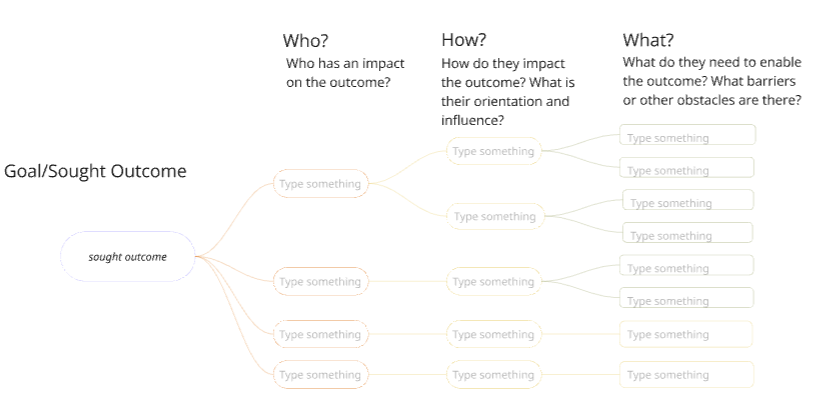
What would you do next? We could return to Causal Loop Diagrams (or more lightweight Influence Maps), or Iceberg Models, etc. We're going to use an Impact Map (adapated from Gojko Adzic's Impact Maps) to explore the socio-technical (and org-political) landscape and enabling outcomes. (You can do this using a Mind Map-like structure shown in the template below, or as a table.)
Goal: State the outcome or goal you'd like to achieve. (This may be a team or org goal, or a goal you have, in the situation you've been exploring.)
Actors: Who can help enable the outcome? Who can obstruct it?
Impacts: For each actor: How does this actor impact the outcome? How can this actor help enable the outcomes? How can they obstruct or prevent us from succeeding? What is their orientation to, and influence on, the outcome?
Our Response: What does this actor need, to enable the (desired) outcome, or to reduce adverse impacts? What barriers can we help move? etc.
Once you've covered several of the key actors/groups who impact the outcome, step back and ask: what are the possible side-effects or consquences of these responses? How do these responses interact? How are we influencing system viability and thriving, and the ecosystem of value (and what is valued)? Who could we involve, to better co-shape responses to the situation?